
Why Chatbots Can't Teach: The 3-Tier Cognitive Engine That Proves You Actually Understand
Reading a chatbot's answer creates the illusion of competence — you feel like you understand, but forget 80% by exam day. Here is how PapinAI's new 3-tier Socratic progression replaces passive chat with verifiable cognitive mastery.
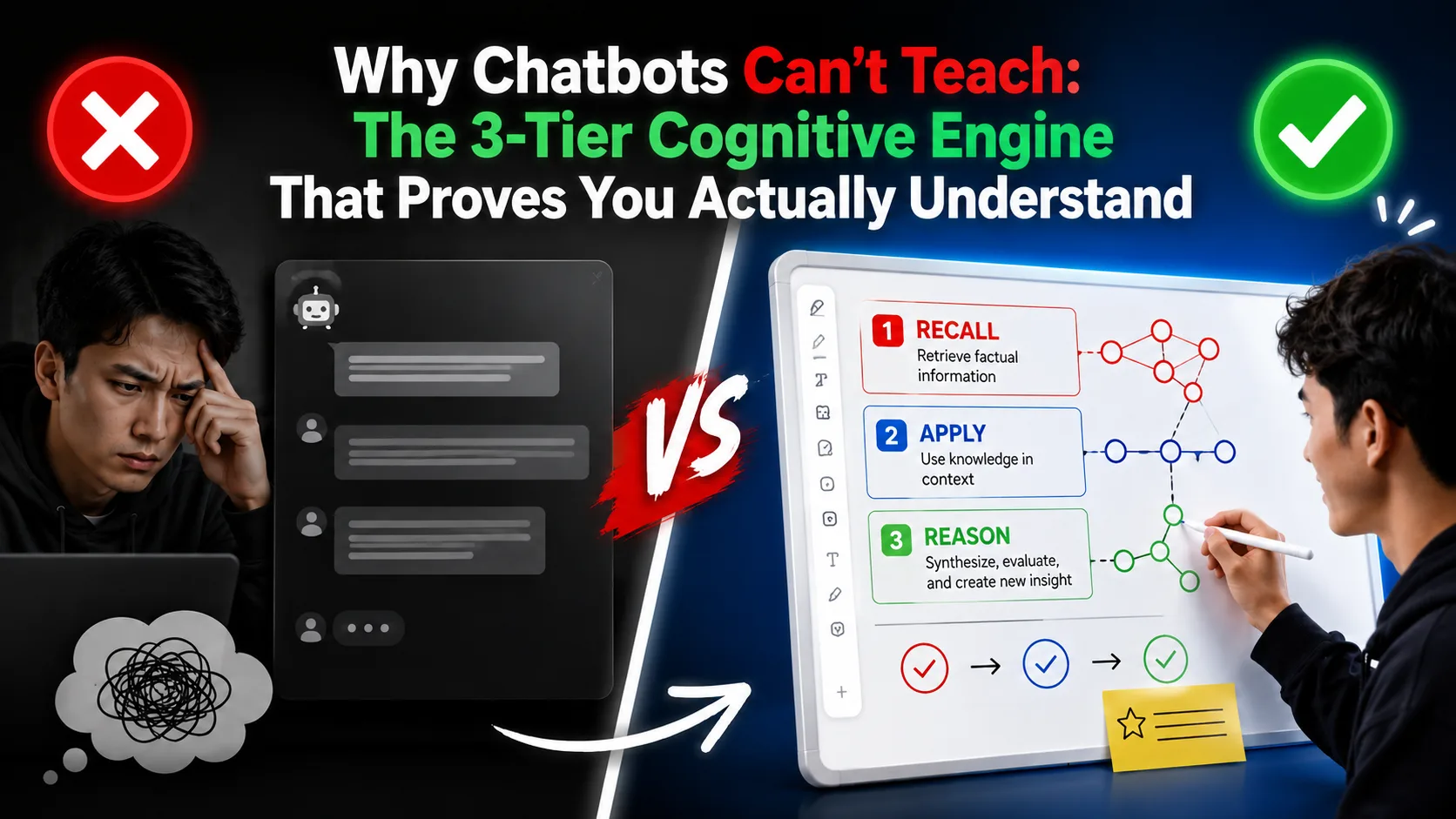
Ask any university student about the last time they used ChatGPT to study for a midterm, and you will hear a familiar story:
They asked the chatbot to explain a tricky concept — say, how a Stripe Webhook handles idempotency or how Backpropagation calculates gradients. The chatbot produced eight beautifully phrased paragraphs. The student nodded along, felt completely illuminated, closed their laptop, and went to bed.
Two days later, when presented with a blank exam sheet asking them to diagnose a duplicate transaction error, their mind went completely blank.
Psychologists call this the Illusion of Competence: reading a clean, lucid explanation triggers the brain's recognition circuitry without ever engaging its generative retrieval pathways. You feel like you understand because the prose is effortless to read. But you haven't actually learned anything.
The 40-year-old discovery that chatbots ignored
In 1984, educational psychologist Benjamin Bloom published one of the most famous findings in learning science: The 2-Sigma Problem.
Bloom proved that an average student tutored one-on-one using Mastery Learning (where concepts are tested actively and verified before moving forward) performed two standard deviations better than students taught in conventional lectures. That is the difference between an average C-grade student and the top 2% of the class.
The secret of mastery learning was never the eloquence of the lecture. It was the presence of cognitive friction. A human tutor does not give you an eight-paragraph speech and walk away. A human tutor draws a diagram, covers one part with their hand, and says: "If the database goes down right here, what does the server send back?"
You are forced to construct the mental model yourself.
Why 1-shot questions are not enough
Many educational apps have tried adding a quiz button at the end of a chat. But asking a single multiple-choice question ("What is the HTTP status code? A: 200, B: 404") is almost as deceptive as the lecture itself. A student can guess 200 by pattern-matching without understanding how the system recovers from a crash.
To provide genuine, verifiable mastery, PapinAI now implements a 3-Tier Socratic Mastery Progression built directly on Bloom's Cognitive Taxonomy:
[ Tier 1: Core Concept Recall (33%) ]
└─ "What signal or status code acknowledges receipt at this step?"
   Tests: Foundational vocabulary and baseline protocol mechanics.

[ Tier 2: Failure & 'What If' Scenario (66%) ]
└─ "What happens if our server crashes after receiving the payload but before writing to DB?"
   Tests: Resilience, edge-case mental models, and state transitions.

[ Tier 3: Synthesis & Real-World Architecture (100% Mastered ✓) ]
└─ "If the payment provider retries and sends the identical event twice, how do we prevent charging the user twice?"
   Tests: Idempotency keys, architectural trade-offs, and engineering best practices.
The whiteboard as an active sandbox
This 3-tier progression is impossible in a plain text chat window because pure text lacks spatial anchors.
In PapinAI, every step of the challenge is physically anchored to the live visual whiteboard:
- Visual Scaffolding: The tutor draws the complete operational flow across the 5x3 kinetic grid.
- The Socratic Blank (
blanknodes): The tutor leaves key decision nodes as dashed mystery boxes marked[ ? ]. - Interactive Resolution: When you voice your reasoning or write the answer with your stylus, the board replaces the mystery box with a solid green confirmation node in real time.
- Mastery Progression Bar: Your progress moves visually from
33% (Recall)to66% (Scenario)to100% Mastered ✓.
Beyond "Token Counting": Pricing that respects learning
The standard business model of generative AI — charging users for raw output tokens — is fundamentally misaligned with education. It incentivizes AI companies to generate long, verbose essays that look impressive but teach poorly.
In a mastery-based model, value is measured in comprehension achieved, not words printed. A student who finishes a 15-minute lesson with a verified 100% Mastered checklist and a clean whiteboard diagram has gained permanent knowledge they can use in an interview or an exam room.
The test of real understanding
Here is the benchmark we build for:
If an AI gives you an answer and you close the tab feeling satisfied, that is a search engine.
If an AI draws a concept with you, challenges your assumptions with a real-world failure scenario, and doesn't let you leave until you have proven the mental model in your own words — that is a teacher.
#Pedagogy #SocraticMethod #MasteryLearning #ActiveRecall #EdTech #CognitiveScience #PapinAI