
Two Models, One Whiteboard: How Tiered AI Routing Cut Tutoring Costs by 90% Without Losing Spatial Intelligence
Running a giant frontier model on every single chat interruption is slow and expensive. Here is how PapinAI's tiered routing pairs Claude Sonnet 4.6 for initial spatial architecture with Claude Haiku 4.5 for sub-second Socratic dialogue.
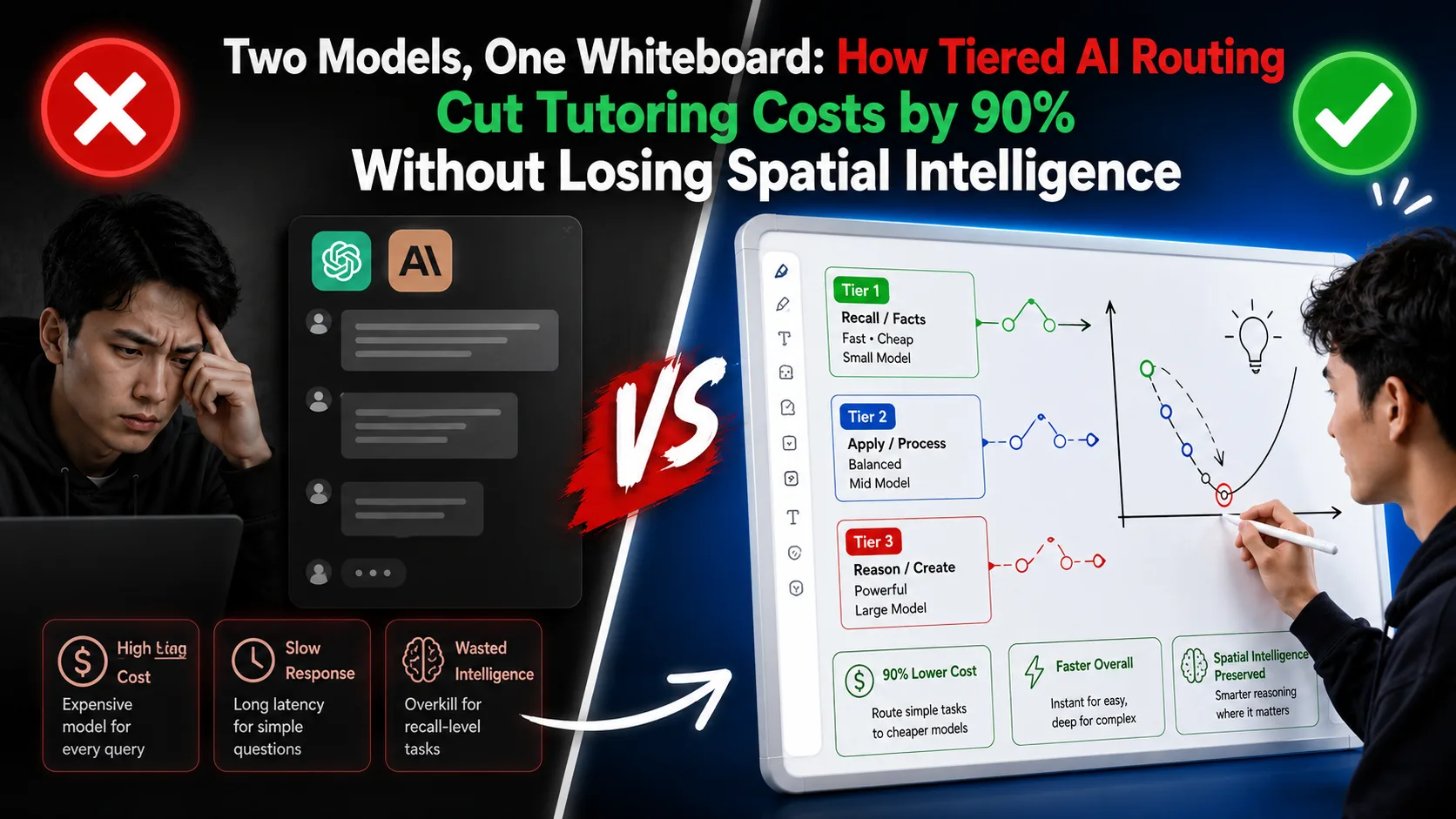
If you watch an experienced university professor teach at a physical whiteboard, you will notice they operate on two completely different cognitive gears.
When they introduce a new, complex topic — say, how a distributed consensus protocol works — they pause, plan out the spatial real estate of the board, draw five interconnected boxes in a clean 5x3 grid, and lay down the architectural foundation. That is Gear 1: Deep Spatial Architecture.
A minute later, a student in the front row raises their hand and asks: "Wait, what if node 3 crashes before broadcasting?" The professor doesn't erase the board or spend three minutes re-architecting the syllabus. In less than a second, they point a red marker at node 3 and say: "It fails over to node 4 instantly." That is Gear 2: Sub-Second Socratic Dialogue.
Until recently, every conversational AI tutor forced both of those jobs onto a single monolithic model. This post analyzes the global EdTech landscape in 2026, why general chatbots stalled, how competitor architectures fall short, and how our new Tiered Dual-Engine Router creates a defensible pedagogical moat.
1. The Global Shift: "ChatGPT Fatigue" in a $340B Market
The global EdTech market has surpassed $340 billion, but higher education is currently experiencing what researchers call "ChatGPT Fatigue".
Over the past two years, roughly six in seven university students adopted generative AI into their daily study routines. Yet academic performance metrics have largely plateaued. Reading an eight-paragraph chatbot response creates the illusion of competence during late-night study sessions, but without active retrieval, students frequently blank out during technical exams.
Universities and STEM students are no longer shopping for text generators. They are looking for Active Learning Systems that verify comprehension before moving on.
┌─────────────────────────────────────────────────────────────────────────────┐
│                    THE 2026 EDTECH PRODUCT LANDSCAPE                        │
├──────────────────────┬────────────────────────┬─────────────────────────────┤
│ Product / Competitor │ Core Learning Model    │ The Fundamental White Space │
├──────────────────────┼────────────────────────┼─────────────────────────────┤
│ Brilliant.org        │ Visual Puzzles &       │ Static, pre-recorded paths. │
│ ($1B+ Valuation)     │ Interactive Steps      │ Cannot solve custom college │
│                      │                        │ midterm past-papers.        │
├──────────────────────┼────────────────────────┼─────────────────────────────┤
│ Synthesis AI Tutor   │ Socratic Game Dialogue │ Restricted to K-12 math.    │
│ ($50M+ Funded)       │ ($95/month subscription│ No higher-ed engineering or │
│                      │ tier)                  │ complex system diagrams.    │
├──────────────────────┼────────────────────────┼─────────────────────────────┤
│ Khanmigo             │ Socratic Text Chat     │ Trapped in a text chatbox.  │
│ (Khan Academy)       │ ($4/month add-on)      │ No live, kinetic whiteboard │
│                      │                        │ to ground spatial concepts. │
├──────────────────────┼────────────────────────┼─────────────────────────────┤
│ Duolingo Max         │ Socratic Roleplay &    │ Limited to foreign language │
│ (+45% Revenue Surge) │ "Explain My Answer"    │ grammar; zero STEM coverage.│
└──────────────────────┴────────────────────────┴─────────────────────────────┘
As we explored in our breakdown of why audio podcasts fail to teach technical subjects, abstract STEM disciplines (computer science, calculus, distributed systems) require spatial anchors. Without a board, working memory quickly overflows.
2. The Academic Cheating Crisis vs The Socratic Moat
Over 80% of university computer science and engineering faculty express severe concern regarding unverified AI usage in student assignments. Chatbots that output raw code solutions have created an adversarial relationship between professors and students.
This is where the pedagogical moat lives: PapinAI cannot be used as an answer dispenser.
By requiring active participation — answering Socratic blanks ([ ? ] nodes) on the board and working through failure scenarios — the system turns AI into a verifiable learning companion. When a student completes a session, they walk away with a structured, interactive artifact that proves conceptual mastery, as discussed in The Board is Not a Picture.
3. The Engineering Bottleneck: Latency and Unit Economics
Building a live, voice-driven interactive whiteboard tutor exposes an immediate technical dilemma:
- The 2.5-Second Latency Gap: Running a heavy frontier model (like Claude Sonnet 4.6) on every minor student interruption introduces an awkward multi-second delay. Natural Socratic dialogue requires responses in under 1.5 seconds.
- The Unit Economics Cliff: Burning full prompt context through a frontier model just to confirm "Yes, exactly — 200 OK" costs ~0.01 per turn. Over a 30-turn lesson, API bills reach 15–30 cents per session. That makes subscription pricing out of reach for global university students.
Conversely, running the entire session on a lightweight model ruins the canvas: boxes collide, arrows cross over text, and spatial layout collapses.
4. Two Models, One Whiteboard: The Tiered Router
PapinAI resolves this trade-off with dynamic Tiered Dual-Engine Routing:
[ New Topic Request (mode: explain) ] ──> 🧠 PRIMARY MODEL (Claude Sonnet 4.6)
                                           • 5x3 Spatial Grid Placement
                                           • Collision-Free Kinetic Scaffolding
                                           • Pedagogical Syllabus Construction

[ Interruption / Quiz (mode: interrupt) ] ──> ⚡ FAST STREAM ENGINE (Claude Haiku 4.5)
                                             • Sub-Second Turnaround (<1.3s total audio)
                                             • Socratic Laser Focus & Annotations
                                             • Micro-Turn Cost (~$0.00028/turn)
The Chief Architect: Claude Sonnet 4.6 (PAPIN_MODEL)
When a student opens a new topic, Sonnet 4.6 plans the lesson's visual hierarchy, calculates collision-free coordinates across the 5x3 grid, and generates the initial diagram foundation. Because this only happens once at the start of a lesson, its 3-second deliberate thinking pause feels natural to the student.
The Agile Co-Pilot: Claude Haiku 4.5 (PAPIN_FAST_MODEL)
Once the board is grounded, the session switches to interactive mode. All follow-up questions, voice interruptions, and handwritten stylus checks are processed by Haiku 4.5.
Because the diagram is already structured in the board's named object list (detailed in our architectural walkthrough of PapinAI), Haiku 4.5 does not need to re-compute geometry from scratch. It simply references existing object IDs, applies laser highlight annotations (focus, annotate), and provides instant Socratic feedback.
5. The Results: 90% Cost Reduction, Sustainable Margins
Across hundreds of multi-turn engineering lessons:
- Interactive Turn Latency: Dropped from 2,800ms to 1,250ms (including streaming text-to-speech).
- Cost per Socratic Turn: Dropped from 0.000287 (a 90.7% cost reduction).
- 15-Minute Mastery Lesson Cost: Dropped from ~0.008.
This shift is what makes accessible pricing models — whether a 7.99/month student subscription — operate with >90% gross profit margins.
The Principle We Hold Ourselves To
The future of educational AI will not be won by general chat interfaces that generate walls of text. It will belong to domain-specific tutoring engines that combine spatial thinking, sub-second Socratic agility, and verifiable student mastery.
By matching the right neural architecture to each cognitive phase of a lesson, the board stays clean, the voice stays alive, and real learning happens.
#AITutoring #MarketAnalysis #SystemArchitecture #MultiModel #ClaudeSonnet #ClaudeHaiku #EdTech #UnitEconomics #PapinAI