
Why AI audio podcasts aren't enough: why real learning needs a whiteboard
AI podcasts sound impressive, but passive audio leaves you with near-zero retention. Here is why spatial visual scaffolding and mid-sentence interruptions change how we master hard topics.
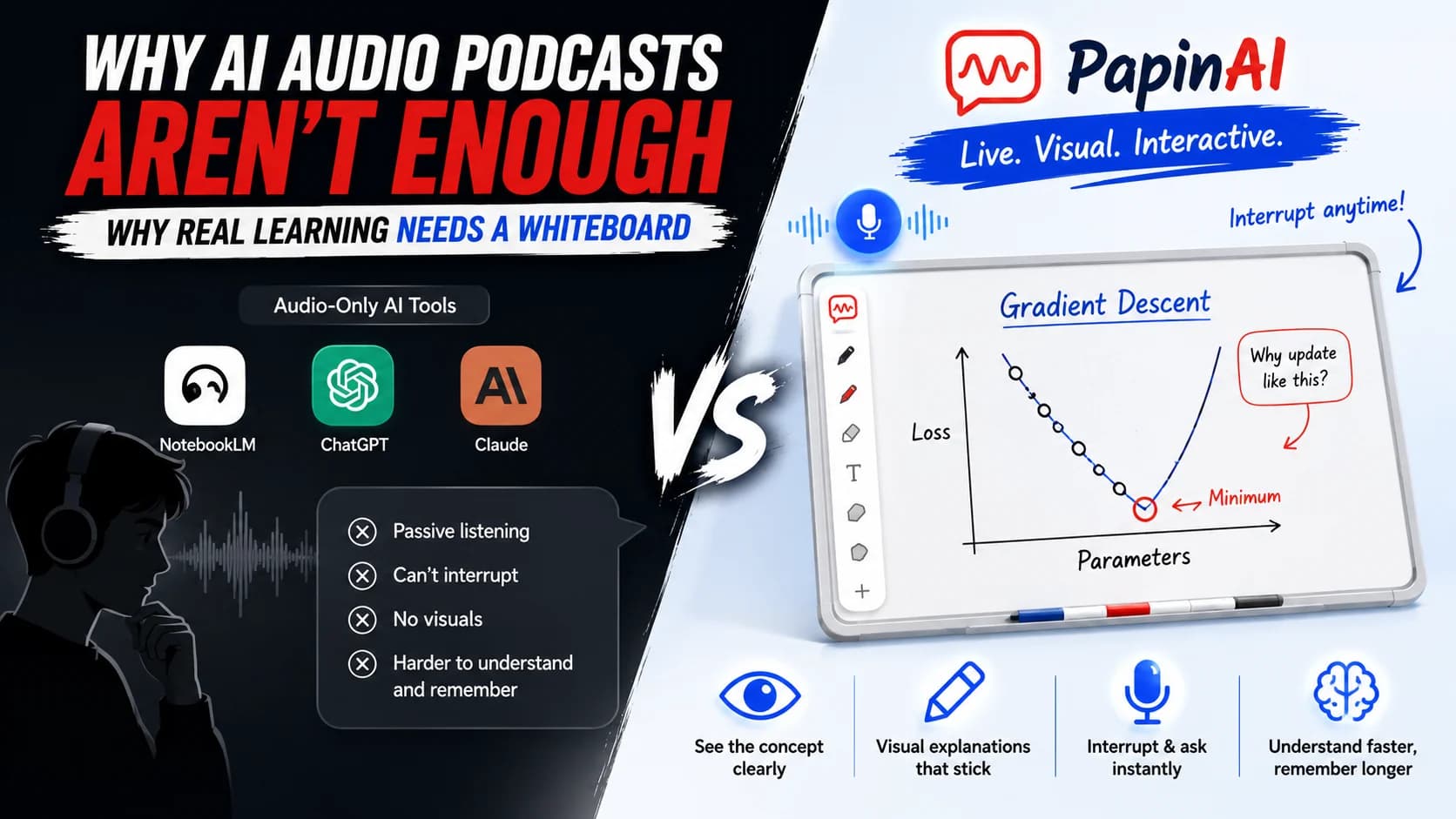
When AI-generated podcasts first appeared, they felt like magic. You feed in a 30-page research paper, and within sixty seconds, two charismatic AI voices are bantering back and forth about transformer attention mechanisms or fiscal policy.
It was entertaining. It was viral. But two weeks later, students and engineers started noticing the same uncomfortable pattern:
You finish listening to a ten-minute AI podcast, you feel like you learned something, and then you sit down to solve a problem — and you realize you cannot remember a single structural relationship.
Why does this happen? And why does real, lasting comprehension require an interactive whiteboard?
1. The Illusion of Competence in Passive Audio
Listening to an audio overview triggers what cognitive scientists call the Illusion of Competence.
Because the AI hosts sound so fluent, articulate, and confident, your brain confuses familiarity with mastery. The ideas sound smooth, so you assume you understand them.
Passive Audio Stream (Podcast)  ──► High Engagement, Low Retention (15–20%)
Interactive Visual Whiteboard   ──► Spatial Scaffolding + Active Recall (75–80%)
In reality, human working memory is severely constrained. Psychologists have known since George Miller's classic 1956 research that our working memory can only juggle about four to seven chunks of information at any given moment.
When an audio podcast rattles off:
"The encoder maps input tokens into continuous representations, which pass through multi-head self-attention before feedforward projection and residual layer normalization..."
Your acoustic buffer overflows by the fifth word. Without a physical, visual anchor on a screen, your brain simply discards the earlier tokens to make room for the new ones.
2. Dual Coding Theory: The Power of the Pen
The human brain does not process the world through audio alone.
Under Allan Paivio's Dual Coding Theory, our cognitive architecture processes information through two separate, independent channels:
- The Verbal Channel: Spoken words, acoustic cadence, narrative intuition.
- The Non-Verbal Channel: 2D spatial relationships, shapes, arrows, color codes, and physical layout.
When both channels are activated simultaneously, learning retention increases by more than 300%.
[ Spoken Voice: "Let's connect X to W" ]
                  │
                  ▼ (Synchronized in real time)
[ Canvas Stroke: Vector Arrow draws from Box X to Box W ]
When you watch a diagram get drawn in real time:
- The canvas acts as external working memory. You do not need to mentally hold the architecture of Step 1 because you can glance at the left side of the whiteboard while Papin is explaining Step 3 on the right.
- The spatial geometry encodes causality. An arrow pointing from top to bottom naturally conveys hierarchy; a dotted red line instantly signals a conditional feedback loop.
3. The Fatal Flaw of Podcasts: You Cannot Interrupt
Think about the last time you sat in a difficult university lecture or had a 1-on-1 session with a mentor.
When the professor writes a confusing equation on the board at minute two, you do not sit quietly for another eight minutes while they finish the lecture. You raise your hand and speak up:
"Wait — why did you transpose that matrix?"
A human teacher immediately stops mid-sentence, takes their marker, points at the exact symbol on the board, and clarifies your misconception. The rest of the whiteboard stays intact.
In an AI audio podcast or pre-recorded video, this is impossible. The audio keeps playing. By minute four, you are completely lost.
AI Podcast / Video:
[ Confused at 02:15 ] ──► Audio keeps playing ──► Student zones out ──► 0% retention

PapinAI Interactive Whiteboard:
[ Student Speaks at 02:15 ] ──► Voice halts (<50ms) ──► Yellow annotation arrow ──► Lesson resumes
4. Active Socratic Challenges vs Passive Listening
There is another critical reason podcasts fail at deep technical teaching: they never test you.
Passive listening requires zero cognitive effort. PapinAI incorporates Socratic Blank Slots [ ? ]. In the middle of constructing a neural network or explaining database sharding, Papin deliberately leaves a mystery card on the board:
"Now, when the cache misses, what component must we query next?"
The session pauses. You type or say "The primary database replica", and the slot flashes green and connects to the diagram. That single micro-interaction turns passive consumption into active mastery.
5. Summary: The Right Tool for the Right Job
| Learning Goal | AI Audio Podcast (NotebookLM) | PapinAI Interactive Whiteboard |
|---|---|---|
| Best Used For | Commutes, casual overviews, entertainment | Hard STEM concepts, coding, math, exam prep |
| Cognitive Modality | 1D Audio (Acoustic only) | 2D Spatial Canvas + Synchronized Voice |
| Working Memory Load | Heavy (Must memorize spoken tokens) | Zero (The board holds the memory) |
| Interactivity | None (Play / Pause only) | Instant Mid-Sentence Barge-In Interruption |
| Testing & Recall | None | Socratic [ ? ] Challenge Cards |
Audio podcasts are wonderful for discovering that a topic exists.
But when you actually need to understand how a system works, nothing replaces a patient tutor standing at a whiteboard with a marker in hand.
Ready to experience real-time visual learning? Launch a free session on PapinAI and try interrupting the AI while it draws.