 Papin
PapinWhy drawing makes hard things easier to understand
Working memory holds about four things. A diagram is external storage you can glance at — and watching one get drawn beats seeing it finished.
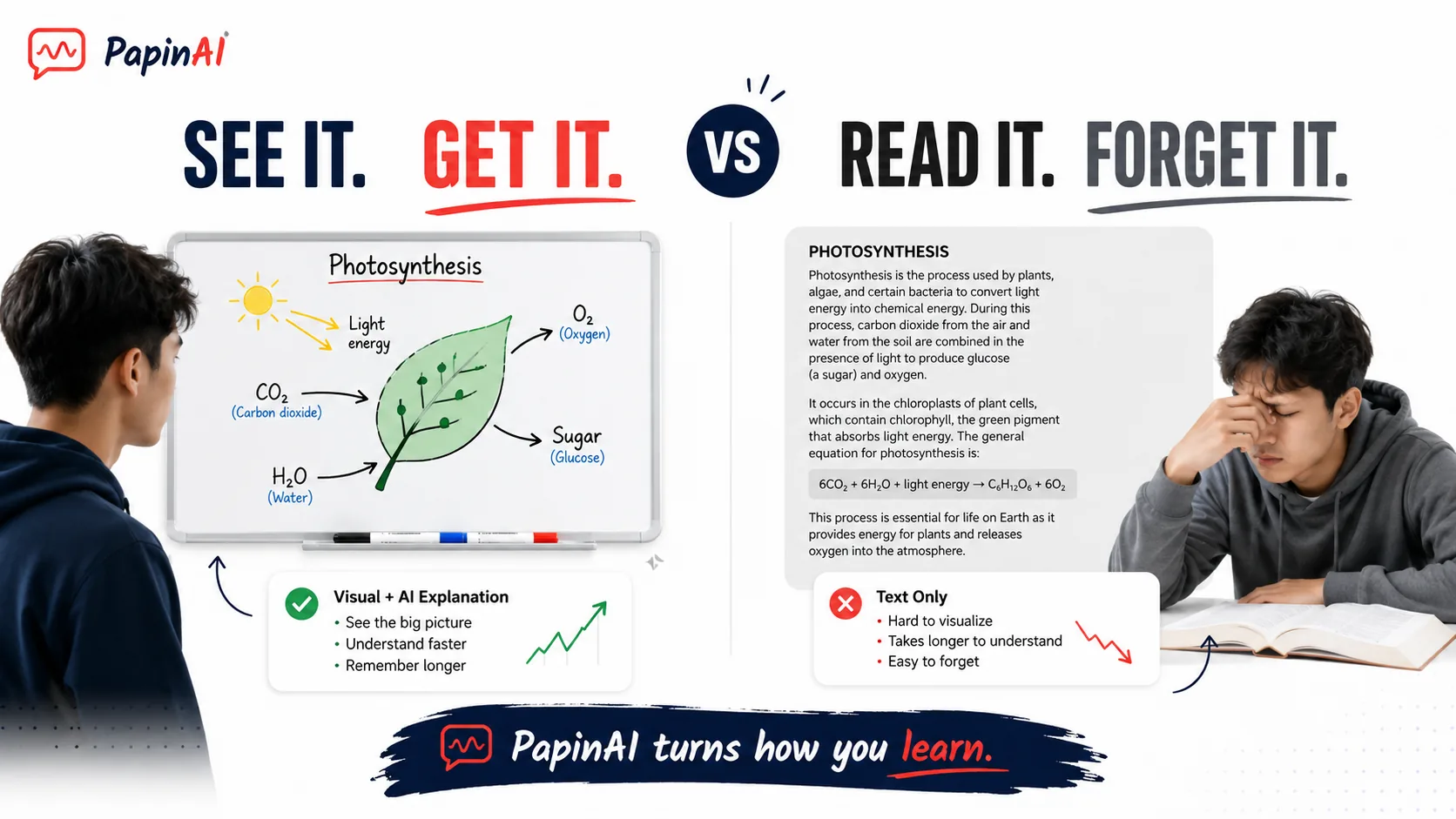
There is a reason every good explanation eventually reaches for a pen. Not because pictures are prettier — because a diagram does something prose structurally cannot.
Understanding why is useful whether or not you ever use an AI tutor. It changes how you take notes.
Prose forces one order; a diagram shows all of them
A sentence is a queue. One idea, then the next, then the next. If a system has four parts that all affect each other, prose has to pick an order — and the order becomes an accidental claim about importance.
Draw the same four parts and the relationships are visible at once. What connects to what, what loops back, what is a dead end. Nothing had to be described in sequence, so nothing acquired a false hierarchy.
This is why the same explanation can feel impenetrable as a paragraph and obvious as a sketch. The content is identical. The number of things you have to hold in your head at once is not.
You can only hold about four things at a time
Working memory is small. Most estimates put it around four items for unfamiliar material — and every part of an explanation you are still holding "in reserve" is one of those slots.
A drawing offloads them. Once a box exists on the board, you do not have to remember it any more; you can look at it. The slot is free for the next idea.
That is the entire mechanism. Not motivation, not learning style — storage. A diagram is external memory you can glance at.
Watching it get drawn beats seeing it finished
Here is the part most people miss.
A completed diagram, handed to you all at once, is nearly as overwhelming as a paragraph. You do not know where to start looking. Everything is present, so nothing is emphasised.
A diagram being drawn, one piece at a time, while someone explains each piece — that is a completely different experience. Each new box arrives with a reason attached. By the time it is complete, you did not just see the structure; you watched it get built, and you can rebuild it.
This is why PapinAI draws while it talks rather than producing a finished picture at the end. The sequence is the teaching.
Drawing it yourself is stronger still
Copying a diagram gets you the storage benefit. Drawing your own gets you something more useful: it forces you to commit to a structure, and being wrong in a specific way is far more educational than being vaguely uncertain.
If you draw the arrow pointing the wrong direction, you have produced a concrete, correctable mistake. A tutor can point straight at it. Uncertainty in your head produces nothing anyone can correct.
This is why the board in PapinAI is not read-only. Sketch a box, name it, and it becomes a real object the tutor can point at, annotate, and connect to — your handwriting and your proportions intact. It builds on your version rather than quietly replacing it with a tidier one.
Three things to try
Draw before you read. Sketch what you think the structure is, then read. You will read looking for confirmation or contradiction, which is a far more active way to read than starting empty.
Redraw from memory a day later. What you cannot reproduce is what you did not understand. Faster and more honest than rereading, which mostly measures familiarity.
Put arrows on everything. Boxes alone are a vocabulary list. The arrows are the actual content — and drawing one forces you to decide what causes what, which is the question you were avoiding.
The catch
Diagrams are bad at nuance. "Usually", "except when", "only if the data is clean" — those live in language, and a box either exists or it does not.
The best explanations use both: a diagram carrying the structure, and a voice carrying the exceptions. Which, when you think about it, is precisely what a teacher at a whiteboard has always been doing.