
Every AI tutor draws now — the difference is what the drawing is made of
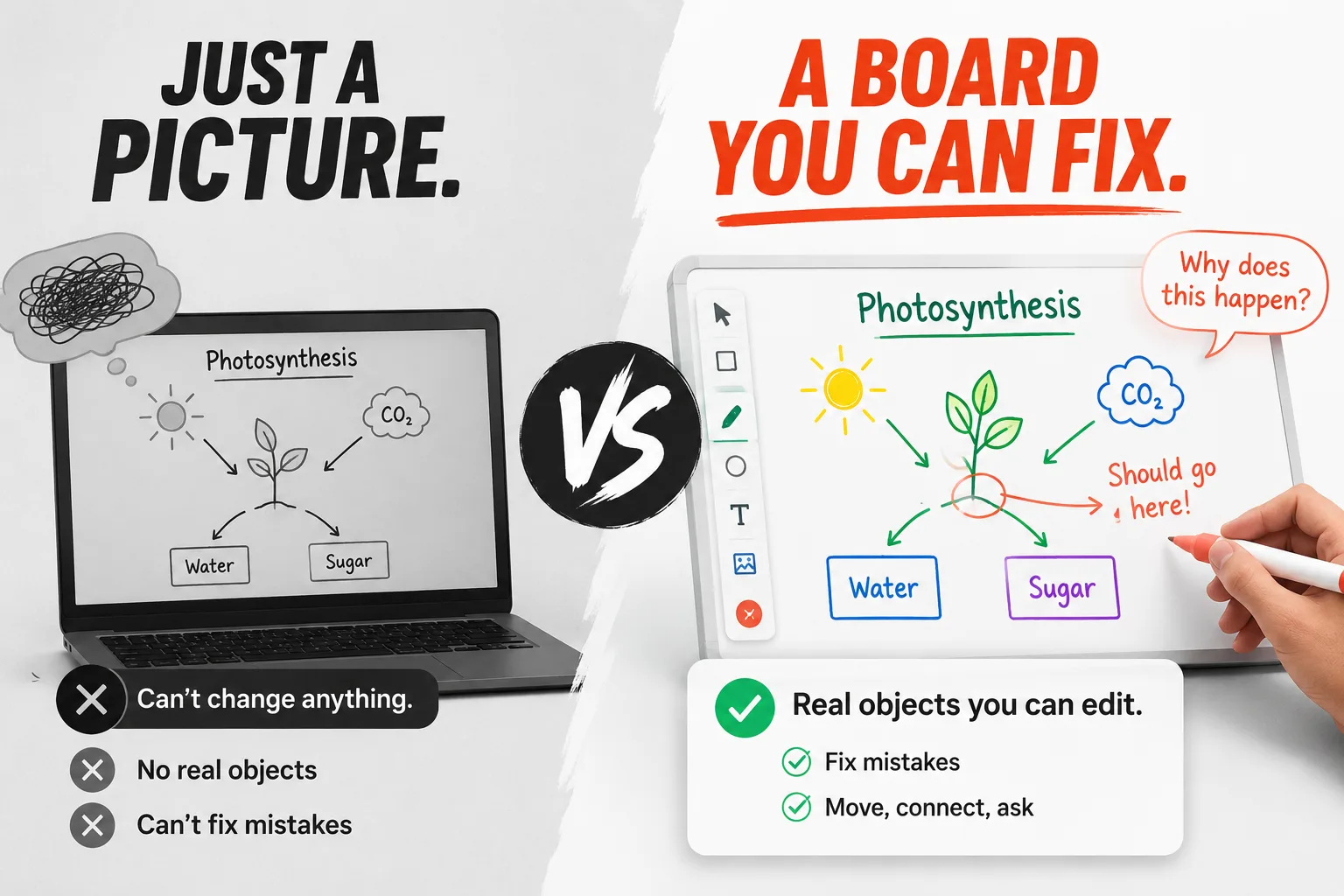
Most tutors that draw produce a picture: finished, unnamed, untouchable. Ours produces a list of objects. Here is what that made possible this month — arrows that stay attached, wrong connections you can fix by hand, and 138 things it can draw instead of writing a label.
Every AI tutor draws now. A year ago that sentence would have described a handful of products; today it describes most of the category. Voice narration, a whiteboard that fills in while the tutor talks, and — increasingly — the promise that you can cut in mid-sentence and it will stop and listen.
So the question worth asking has moved. It is no longer whether a tutor draws. It is what the drawing is made of.
The crowd arrived this year
The defining shift in educational AI this year is the move away from general chatbots toward tools built for teaching specifically. That shift is real, and it has been good for students. Roughly six in seven university students now use AI as a routine part of studying, and the tools they reach for have started to look less like a chat window and more like a lesson.
Several products now do close to what we do. Some of them are good. If you are shopping around, you will find voice tutors that sketch while they speak, tutors that let you interrupt, and tutors that remember what you covered last week. We would rather tell you that than have you discover it and wonder what we were hiding.
What none of that settles, however, is a quieter question: after the drawing appears, what can you do with it?
A picture cannot be corrected
Most tutors that draw produce a picture. The model writes something — a description, a diagram language, an image prompt — and a renderer turns it into pixels. The result can be beautiful. It is also finished. Nothing in it has a name, so nothing in it can be referred to later, moved, or repaired.
Our board works the other way around. It is a list of named objects, and the picture is what that list happens to look like at the moment. When the tutor says "the hidden layer," there is an object called hidden-layer that both of you are pointing at. When it draws an arrow, the arrow does not merely land near two boxes — it belongs to them.
That sounds like an implementation detail. It is the reason interruption works at all. Cutting in does not throw away a picture and start another one, because there was never a picture to throw away; there is a list, and your question edits it. Furthermore, it is the reason the rest of this post is possible.
Arrows now belong to the shapes they connect
Drag a box across the board and the arrows follow it. They stay attached to the edge of the shape, they stop where the shape actually ends rather than somewhere near it, and their labels sit at the middle of the line instead of drifting toward one end.
This matters more than it sounds. A diagram you can rearrange is a diagram you can think with. Students move things — grouping what belongs together, pulling apart what got crowded, dragging the confusing part to the middle of the screen. If the arrows break when you do that, you stop doing it, and the board quietly becomes a picture after all.
Arrows also take the shortest honest path now. Two objects that can be joined by a straight line get one, and the line meets the shape's real outline: a circle at the curve, a diamond at its slanted side. Elbows appear when something is genuinely in the way, which is what an elbow is for.
When you fix the tutor's arrow, the tutor learns it
Sometimes the tutor connects the wrong two things. It is worth being plain about that, because every product page in this category implies otherwise.
You can now drag the end of an arrow onto the object it should have pointed at. The correction sticks, and the tutor sees it — not as a picture that changed, but as a fact about the diagram that is now different. Ask a follow-up question and it answers with your correction in hand.
We spent a while deciding between that and the obvious alternative, which was to remember the exact path you dragged. The exact path is worse, and the reason is instructive: the moment either shape moves, that saved path is wrong, and the arrow snaps somewhere unexpected. Storing the relationship instead of the drawing never goes stale. In contrast to a picture, a relationship survives everything that happens to the layout afterwards.
A hundred and thirty-eight things it can draw instead of writing a label
A box with the word "bird" written inside it is engineer's notation. A parent explaining animals to a child does not draw a box; they draw a bird. The child might follow the box. They will certainly follow the bird.
The tutor can now draw one hundred and thirty-eight symbols — animals, plants, weather, food, vehicles, tools, and a wide vocabulary of the abstract things that come up in technical subjects. None of them come from an icon library. Icon sets are built to be geometric at sixteen pixels, and next to a hand-drawn board they look imported. These are drawn as pen strokes, no more than five per symbol, because anything busier becomes a smudge at the size it actually appears.
They take their colour from the object holding them, so a symbol inside a blue box is blue, and inside a purple one, purple. That is one decision made once rather than a palette to maintain, and it means the board stays coherent no matter which symbols a lesson happens to need.
What still does not work
The tutor still occasionally routes an arrow across a lesson above it when a board gets tall. Voice can leak into the microphone if you use speakers rather than headphones, so it sometimes hears itself and pauses. And it draws faster than it should on very dense diagrams, which is a pacing problem rather than a correctness one.
We would rather list those than let you find them during an exam week.
The test we hold ourselves to
Here is the honest measure of whether any of this worked. Ask for an explanation, let it draw half of it, then interrupt with a question about the part already on the board. If the tutor answers by annotating what is there and carries on from where it stopped, the board is doing its job. If it starts over, or answers in a wall of text beside a frozen image, it was a picture all along.
That is the only question this project exists to answer, and every change above was judged against it.