
Who PapinAI is for — and who it is not for
It is built for one moment: a subject stopped making sense somewhere and you cannot find where. Here is that moment, what you get, and the cases where another tool is the better use of your evening.
Most study tools describe who they are for in a way that includes everyone. "For students." "For lifelong learners." That is a marketing sentence, not an answer, and it leaves you to work out for yourself whether the thing is worth your evening.
So here is the specific version, including the parts where the answer is no.
The moment this is built for
You are three weeks into a subject that builds on itself. Databases, circuits, statistics, organic chemistry — something where week four assumes week three landed.
It did not land. You know roughly where it stopped making sense, but not exactly. And the lecture has moved on.
You cannot ask the lecturer, because the lecture is over and the question feels too basic to send by email. You cannot ask a friend, because they are three weeks behind in a different place. So you open a chatbot, type the question, and get eleven paragraphs that are all correct and none of which tell you where your understanding broke.
That is the moment. Not "I want to learn something new" — that is well served already. The gap is "I lost the thread and I need to find the exact place I lost it."
What you actually get
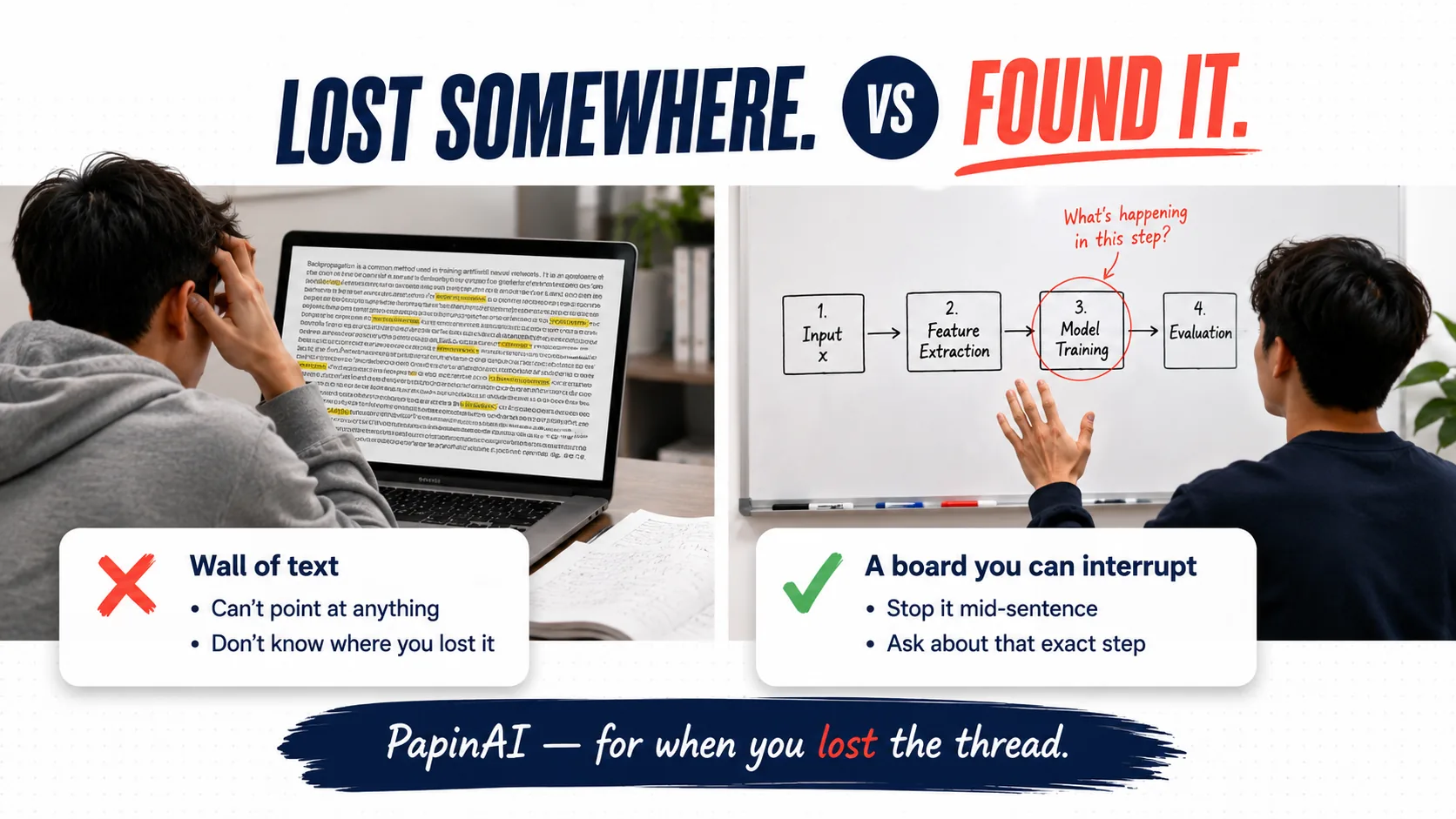
A picture that builds while it talks. Not a finished diagram handed to you — that is nearly as overwhelming as a paragraph, because you do not know where to start reading. It appears in the order it is explained, so the sequence of the drawing is the sequence of the idea.
The ability to cut in mid-sentence. This is the part that matters and the part that is hard to appreciate before you have done it. Not "wait for it to finish, then ask a follow-up" — actually stopping it, mid-stroke, at the exact object that confused you. It answers by marking up what is already on the board and then carries on. It does not start over.
That last detail sounds small. It is not. A tutor that restarts when interrupted quietly teaches you to stop interrupting — and once you stop interrupting, you are back to watching a video.
A board that stays. Everything drawn is still there at the end, so you can point back at it. "This box — why does it come before that one?" It knows which box you mean, because the board is something it can read, not just something it produced.
What that is worth, in plain terms
You find the break faster. Instead of re-reading a chapter hoping the confusion dislodges itself, you point at the step and ask. The diagram makes the step pointable in the first place.
You stop confusing familiarity with understanding. A fluent explanation feels like comprehension while you are reading it. A diagram you have to follow — and interrupt — does not let you coast in the same way, because you have to decide where you are lost in order to ask.
You keep the artefact. At the end you have a diagram of the thing, built in the order it makes sense, with your own questions marked on it. That is a better revision object than notes taken while trying to keep up.
Who it is not for
Being honest about this is more useful than pretending otherwise.
If you want an answer, not an explanation — the big general assistants are faster, and you should use them. Watching something get drawn is slower than reading a paragraph. That slowness is the point when you are stuck; it is a waste of your time when you are not.
If your subject has no shape — memorising vocabulary, drilling grammar, learning dates. A whiteboard adds nothing to a flashcard. Use a flashcard.
If you need graded practice — there is no exercise bank here, no mastery tracking, no problem sets that adapt. Khan Academy's library is a real advantage that we have no equivalent to, and a tutor is not a substitute for doing the problems.
If you want it to write the essay — it draws and explains. It is not a ghostwriter, and it is deliberately bad at being one.
The honest summary
This is a whiteboard you can argue with, for the specific situation where a subject stopped making sense somewhere and you need to find where.
If that is your situation this week, it is worth an evening. If it is not, one of the tools above is a better use of your time — and knowing which is which is more valuable to you than another list of features.